16. April, 2026delish0
In the production process of thermal transfer ribbon, slitting is a key process. The winding quality after slitting directly affects the performance of the ribbon, and the large diameter difference between the two ends of the winding is a common but easily overlooked problem in the industry. This defect not only leads to poor appearance of the finished product, but also causes serious failures such as tension fluctuations, belt deviations, and even belt breakage during subsequent printing.
1. What is "the diameter difference between the two ends is too large"
Under normal circumstances, the winding end face should be flat and the diameter of both ends should be the same after ribbon slitting. When the difference in coil diameter between the left end (by the operating side of the equipment) and the right end (by the non-operating side of the equipment) exceeds a certain threshold, usually greater than 1.5mm (depending on the bandwidth and substrate thickness), it is judged that the diameter difference between the two ends is too large. It is manifested as a prominent bulge at one end of the core and a concave end at the other end, in the shape of a "bell" or "cone".
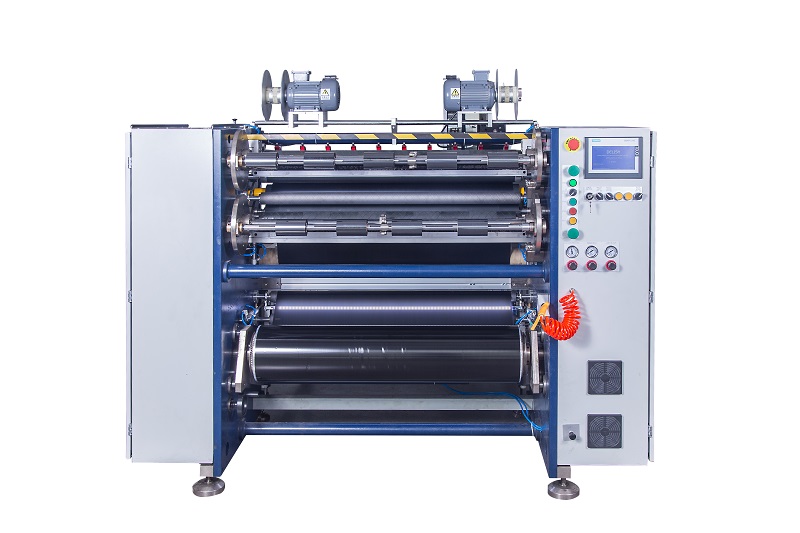
2. Systematic analysis of the causes
The factors that cause this problem are usually not singular but the result of the interaction of machinery, process, and materials.
1. Insufficient precision of the mechanical system
• The straightness of the rewinding shaft exceeds the standard: long-term use or accidental impact causes the rewinding shaft to bend, the axis line is not parallel to the pressure roller and guide roller, and the linear speed at both ends is inconsistent.
• Bearing wear or excessive clearance: The bearing state at both ends of the winding shaft is different, resulting in large operating resistance at one end and inconsistent equivalent tension.
• Uneven pressure at both ends of the roller: The pressure setting or actual output at both ends of the pneumatic roller or mechanical spring pressing device is different, resulting in uneven distribution of friction along the width.
• Slip shaft slip difference difference: If the equipment uses slip shaft winding, the slip torque of each slip ring is factory set or wear is inconsistent after use, and the impact is particularly obvious when coiling.
2. Improper setting of process parameters
• Asymmetry of winding tension: Some old equipment or simple slitting machines use unilateral tension detection feedback, and the actual tension at both ends cannot be controlled independently.
• Unreasonable start-stop acceleration and deceleration curve: During the acceleration and deceleration process, if the inertia compensation of the retraction shaft is inaccurate, the end with a small diameter is more likely to be stretched or relaxed.
• The winding pressure is set too high or too low: the pressure is too high, and the friction between the ribbon layers near the driving end causes the inner ring to be pressed and extrusion; if the pressure is too small, the core slips and causes uneven winding.
3. The impact of raw materials and incoming materials
• Uneven end face of the master roll: poor winding in the upstream coating link, even if the equipment is ideal during slitting, it will inherit the problem of uneven end face.
• When the thickness tolerance of the substrate is large:P when the lateral deviation of the thickness of the ET film exceeds ±0.5μm, it will be magnified as a diameter difference after multiple layers are accumulated.
• Static electricity leads to local adsorption: In a dry environment, the electrostatic adsorption between the back of the ribbon and the winding layer is uneven, and the local coil is tight and the local coil is loose.
4. Operation and maintenance factors
• Insufficient roundness of the paper core or plastic core: the core itself is not rounded or the inner diameter of both ends is inconsistent, and it is eccentric after installation.
• Belt path offset: The ribbon is not strictly centered when the operator wears the belt, and one end continues to accumulate during the deviation compensation process.
• Failure to calibrate regularly: The parallelism of the roller and the horizontality of the rewinding shaft are not re-checked after long-term operation.
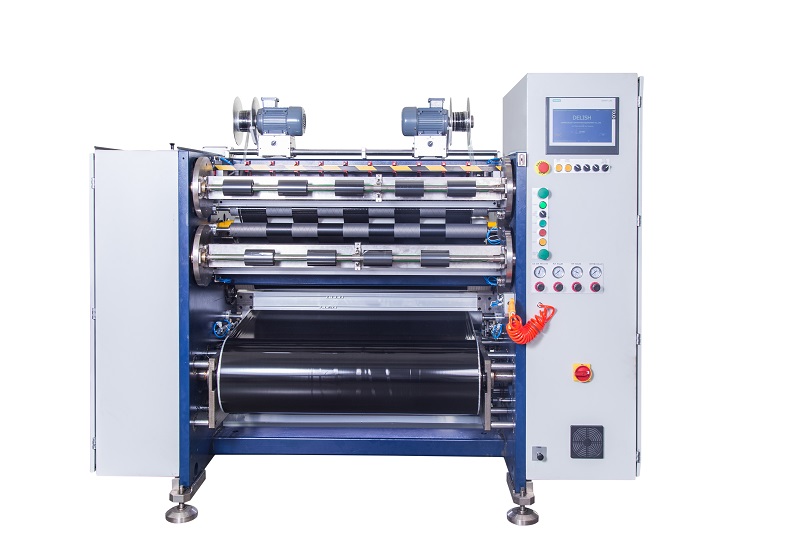
3. Hazards and impacts
| Affected objects | Specific performance |
| Print for use | The ribbon does not match the width of the label, and the printed content is offset, wrinkled, and broken |
| Later process | Automatic packaging cannot be accurately boxed, making it difficult for customers to get on the machine |
| Equipment life | The unwinding shaft is stressed on one side, accelerating the wear of bearings and transmission parts |
| Corporate reputation | Customer complaint rates have risen and return losses have increased |
4. System solutions
To solve this problem, the principle of "diagnosis first, then adjustment, and then verification" should be followed.
Step 1: Mechanical troubleshooting and recovery
1. Check the straightness of the rewinding shaft: remove the shaft and place it on the V-shaped iron, check it with a dial indicator, and the bending amount should be straightened or replaced if it exceeds 0.1mm/m.
2. Correction of parallelism: Use laser centering instrument or wire pulling method to ensure that the winding shaft, pressure roller, and guide roller are parallel in the horizontal plane and vertical plane, and the error is controlled within 0.05mm/m.
3. Replace the bearing: Check the rotating feel of the bearings at both ends, and the side with jamming or clearance exceeding the standard must be replaced.
4. Detect the pressure at both ends of the pressure roller: Use a membrane pressure sensor or feeler gauge method to adjust the position of the air pressure circuit or spring to make the width of the indentation at both ends consistent.
Step 2: Process optimization
• Tension segment control: For qualified slitting machines, enable the "taper tension control" mode, gradually reduce the tension when the winding diameter increases, and reduce the extrusion of the outer layer on the inner layer. The recommended taper coefficient is set at 30%~50%.
• Independent side tension adjustment: Some high-end devices support independent fine adjustment of left and right tension, and adjust the winding tension on the deviation side in units of 0.5N~1N.
• Optimized acceleration and deceleration time: Extend the acceleration time from 3s to 6~8s, and the deceleration time is similar to avoid instantaneous impact.
• Adjust the winding pressure: set according to the recommended value of the material, usually the ribbon winding line pressure is in the width range of 1.5~3.5N/cm. The pressure is tested from small to large, and the minimum pressure that does not slip is found.
Step 3: Materials and operating specifications
• Incoming material inspection: use a vernier caliper or laser diameter gauge to check the height difference of the end face of the master coil, and do not put into slitting if it exceeds 1mm.
• Coil core standardization: uniformly adopt high-precision plastic core, roundness ≤ 0.1mm, and inner diameter tolerance at both ends ±0.05mm.
• Static Elimination: Install an AC static elimination rod before winding to control the electrostatic voltage within ±500V.
• Operation SOP: It is mandatory to align the ribbon with each roll marking line when threading the tape, and perform the "first roll inspection" after each specification change.
Step 4: Online detection and closed-loop control
Qualified enterprises can invest in installing an online laser diameter measurement system, arranging sensors at both ends of the winding shaft to monitor the diameter difference in real time. When the difference exceeds the set threshold (e.g. 0.8mm), the system automatically fine-tunes the torque of the winding motor on one side or the slip setpoint of the slip ring to achieve closed-loop control.

5. Case reference
An abnormal rate of 2.5>mm in diameter difference of a ribbon manufacturer is as high as 12%. After investigation, it was found that the rewinding shaft was bent by 0.3mm due to the knife collision, and the right bearing was damaged. After straightening the shaft and replacing the bearing, the problem rate drops to less than 3%. Subsequently, independent adjustment devices were added at both ends of the pressure roller, and finally stabilized within 1.5% for a long time.
6. Conclusion
The large diameter difference between the two ends of the ribbon slitting machine is a multi-factor coupling engineering problem, and simply adjusting the process or replacing parts often treats the symptoms rather than the root cause. The correct idea is: based on mechanical precision, process optimization as the means, material control as the guarantee, and online monitoring as the direction of improvement. Through systematic investigation and improvement, it can be completely controlled within the qualified range, so as to ensure the reliability of the back-end use of ribbon products and the market competitiveness of enterprises.
Regular maintenance records, standardized order changeovers, and continuous process data tracking are the three last lines of defense against the recurrence of the problem. Every flattening of the end face reflects a deep understanding of "coil quality" by a ribbon manufacturing company.
 English
 Deutsch
 Français
 Español
 Português
 日本語
日本語 русский
 한국어
한국어 عربي
عربي ภาษาไทย
 Tiếng Việt
 Italiano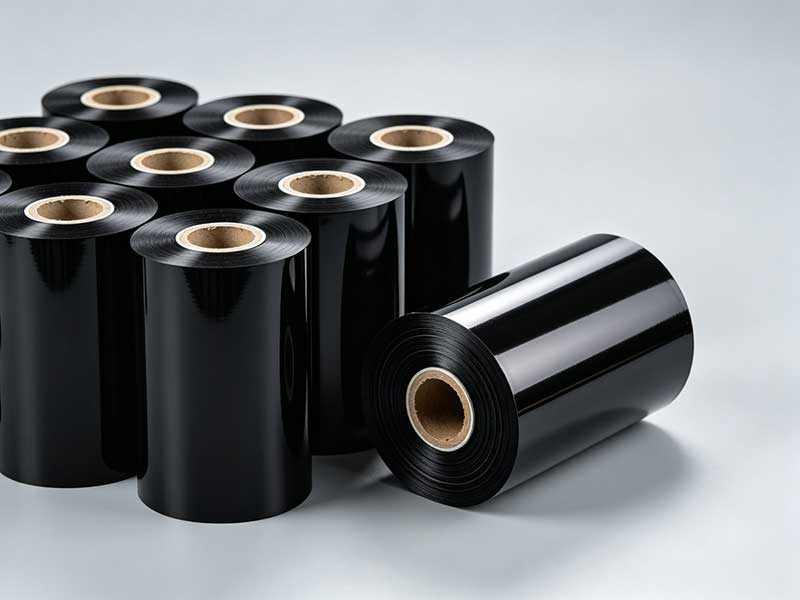
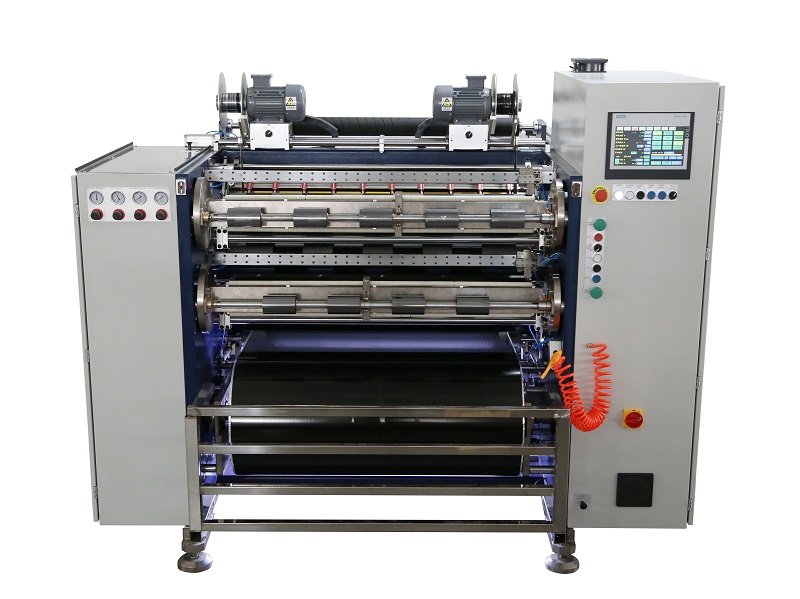 Fully Automatic TTR Slitter RSDS8 Plus
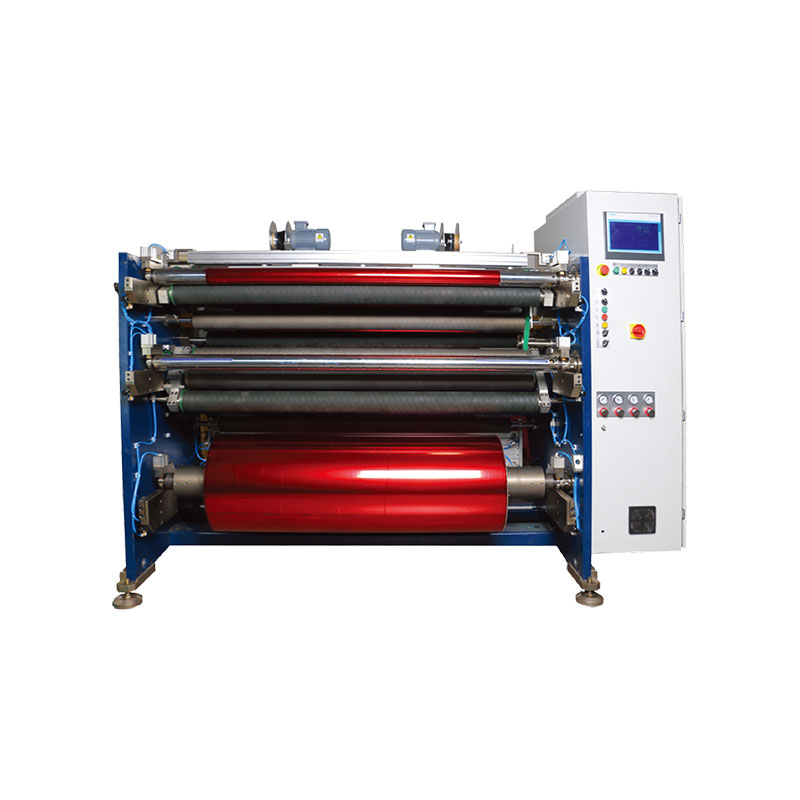 Hot Stamping Foil Slitter 1600mm
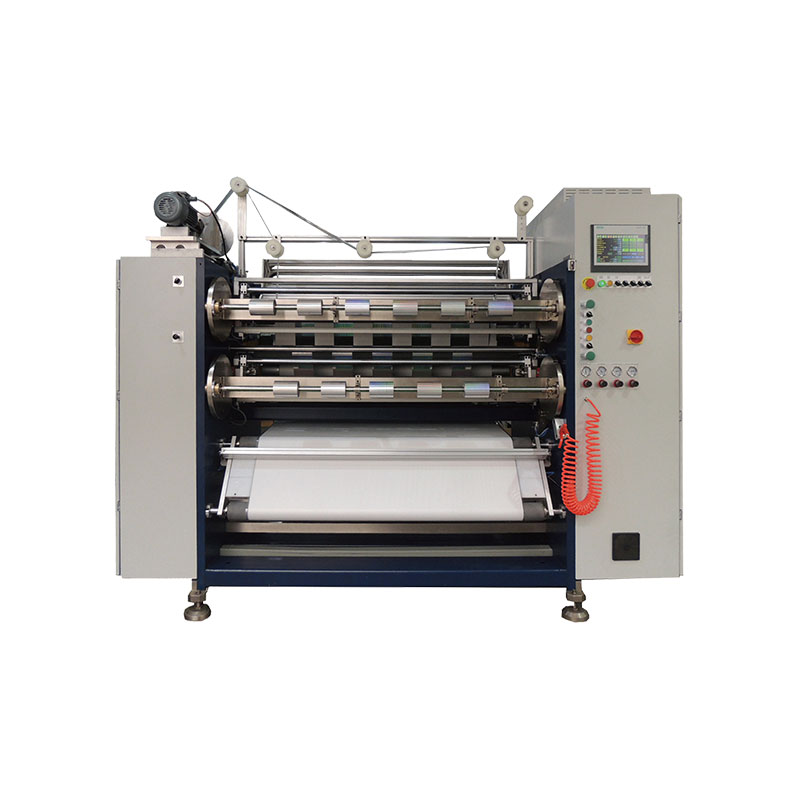 Hot Stamping Foil Slitter (4 Shafts)
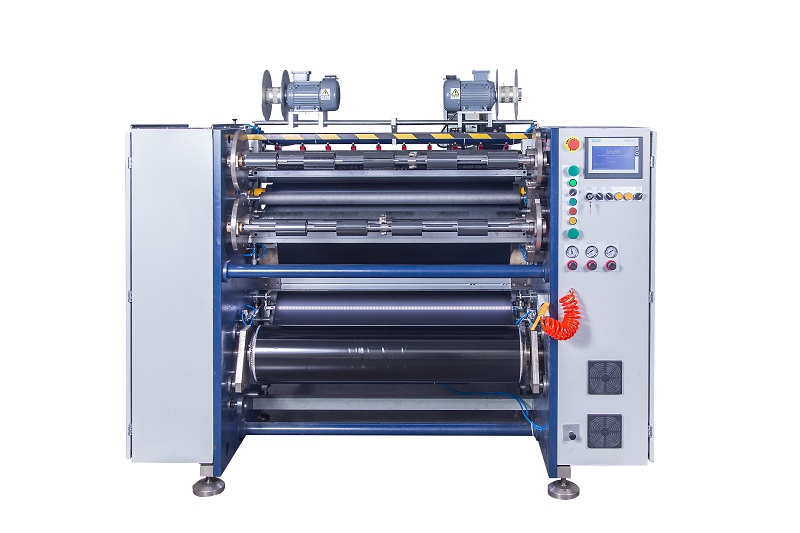 Semi-Auto TTR Slitter RSDS2 Plus
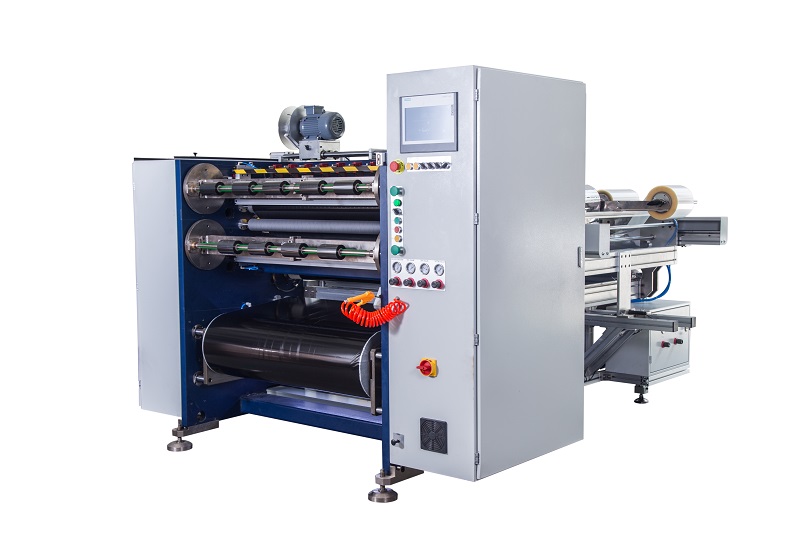 Semi Automatic TTR Slitter RSDS5 Plus
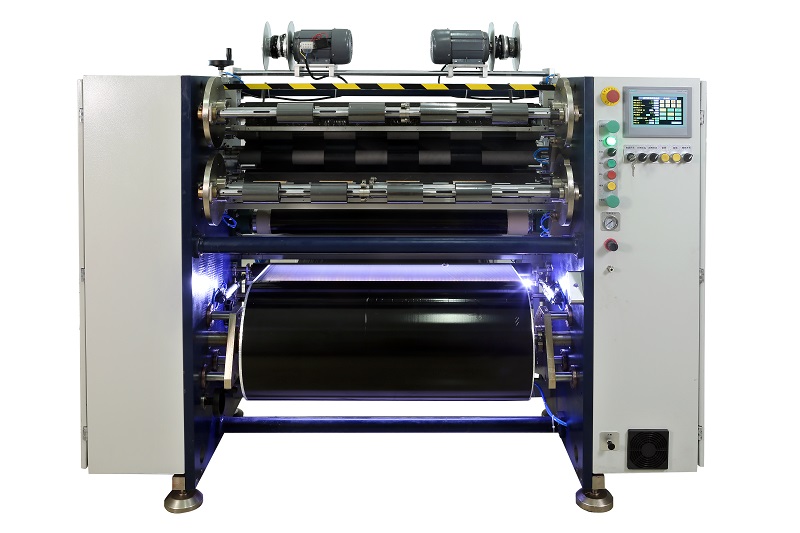 Manual TTR Slitter RSDS2
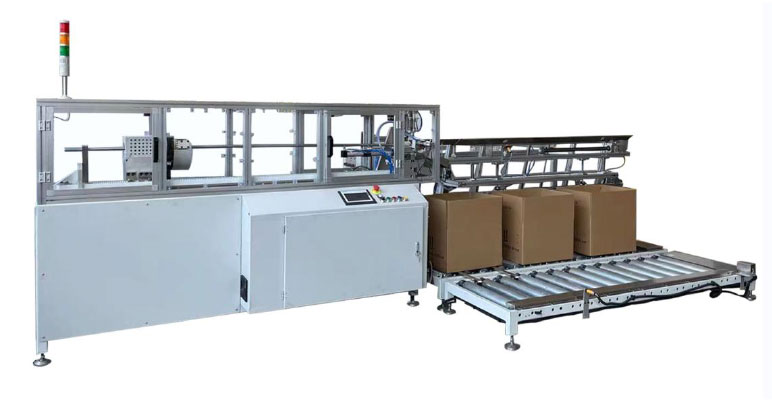 Auto Paper Core Cutter
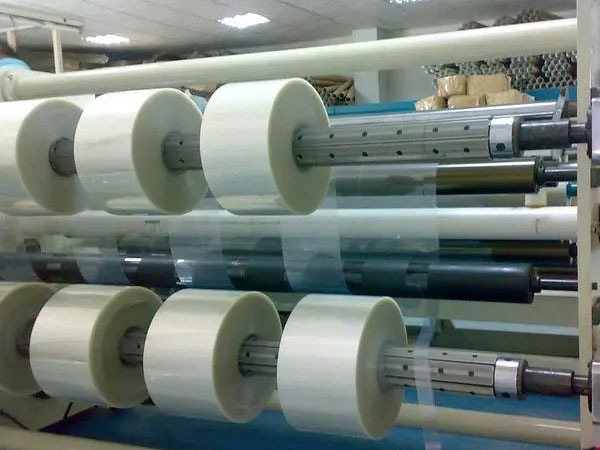 Film Slitting Machine



 +86 135 9951 7291
 support@delishgroup.com
 +86 135 9951 7291