05. November, 2026delish0
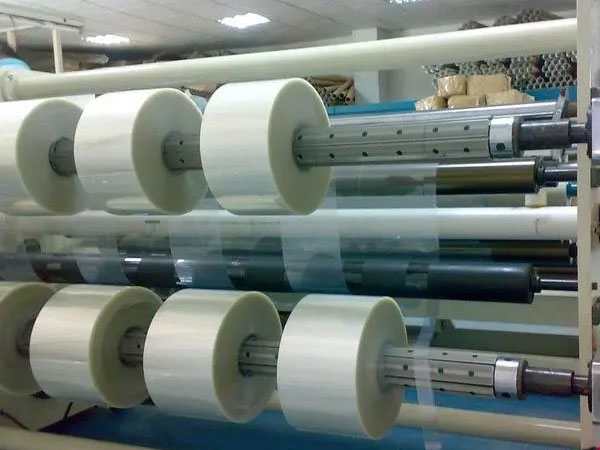
Hot foil stamping and slitting are key upstream steps in the stamping process, and their quality directly determines the success rate of subsequent hot stamping products. There is a saying in the industry that "30% hot, 70% cut," and the core lifeblood of slitting quality almost entirely depends on tension control. Hot stamping foil is usually made of PET as the base material, with a total thickness of only 12–30μm. Its surface is laminated with a release layer, color layer, aluminum coating, and adhesive layer. It has a thin structure and high brittle coating, making it much more sensitive to mechanical stress than ordinary packaging films. Excessive tension causes the substrate to stretch and deform, coating cracks, and sleeve misalignment during hot stamping of the finished product; If the tension is too low, the rolls become loose, the ends face uneven, and even develop "chrysanthemum core" wrinkles. More challengingly, slitting speeds have been pushed from the traditional hundred meters per minute to 300–500 m/min, and millisecond-level tension fluctuations can leave irreversible quality risks on thousands of meters of foil ribbons. Therefore, tension control technology has long surpassed the naive idea of "tightening foil" and evolved into a dynamic servo closed-loop system covering the entire process of unwinding, traction, and rewinding.
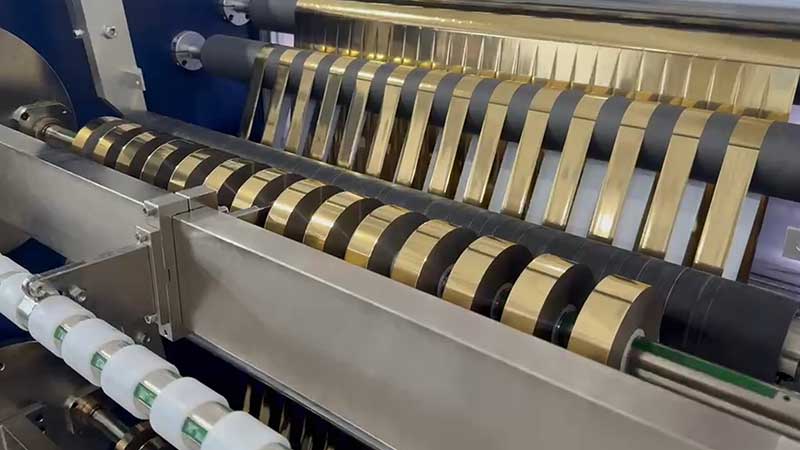
Unwinding section: anti-taper control and disturbance isolation
Unwinding is the starting point of tension and also the section where the diameter changes most dramatically. From full roll to hollow core, the coil diameter is several times or even more than ten times the usual ratio, and the moment of inertia changes significantly. If the unwinding end cannot be adapted in real time, tension fluctuations will be directly transmitted to the cutter, causing dimensional deviations in slitting or material wrinkling. Traditional solutions mostly use magnetic powder brakes to provide reverse torque, achieving stepless adjustment by adjusting the excitation current. However, the control logic does not pursue "constant tension"—on the contrary, the unwinding end requires anti-taper control: as the coil diameter decreases, the braking torque automatically decreases according to a preset curve, ensuring that the foil maintains similar surface stress at the moment of master roll separation. If the braking torque does not decrease with the coil diameter, the bottom layer of the large coil is easily overstretched, and longitudinal stripes appear when unfolded. The reference tension for unwinding hot stamping foil usually falls within the range of 3N to 8N. At high speeds, lateral shaking can slightly increase by 5%–10%, but once longitudinal stretch lines are observed, they must be immediately reset. Additionally, de-rewinding correction and tension control need to be functionally decoupled. Photoelectric sensors detect the edge position of the female roll and drive the unwinding seat to move laterally. If the correction response is too slow, it can accumulate offset, while excessive force may introduce new serpentine oscillations. Each serves its own role to provide a stable entry point for the fundamental tension.
Winding Section: Taper Reduction and Segmentation Strategy
Rewinding is the final manifestation of slitting quality. During winding, the diameter increases from hollow to full. If constant tension is maintained, the outer material will continuously compress the inner layer, causing the end face to slide at best, or the core to be compressed into chrysanthemum-shaped wrinkles. Therefore, taper tension control has become the standard logic for hot stamping foil winding: tension decreases according to a preset curve as the diameter increases. The taper coefficient of hot stamping foil is usually 0.5–0.8, with initial tension set at 8%–12% of the material's breaking tension, and final tension at 40%–70% of the initial value. A more refined solution uses segmented control: the starting section (roll diameter 0–20%) ensures a smooth and fitting core with lower tension; Constant tension segments (20%–70%) maintain stable interlayer pressure; The taper descent section (70%–100%) gradually reduces tension to compensate for the extra compression effect caused by the outer ring's own weight on the inner layer. The value of this segmented strategy lies in recognizing that the mechanical requirements at different stages of the winding process are fundamentally different, and a single fixed-slope taper curve cannot simultaneously meet the dual goals of core bonding and outer layer anti-loosening.
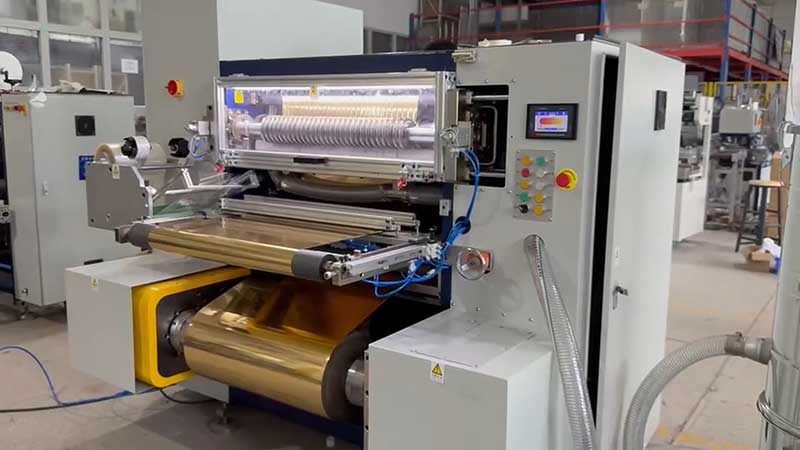
Coupling of pressure rollers and tension: an underestimated synergistic dimension
Tension control does not operate in isolation. The pressure roller is responsible for pressing the foil onto the core, expelling air between layers, and providing frictional traction. There is a deep coupling between its state and the tension setting. If the axis of the pressure roller and the winding shaft is not parallel, and the pressure deviation exceeds 0.05mm/m, the foil surface will have one side tight and the other loose, with the loose side easily wrinkling. Roller hardness is also crucial: overly hard rollers cannot adapt to slight fluctuations in foil thickness, while overly soft ones easily deform and cause uneven pressure distribution. For hot stamping foil, it is recommended to use polyurethane or nitrile rubber roll surfaces with Shore hardness of 60–75. A more hidden issue lies in the timing coordination between pressure and tension. At the initial stage of winding, the coil diameter is small, requiring high contact pressure to expel air; In the later stage of winding, the diameter increases, and the contact pressure should gradually decrease. If the tension taper has decreased but the pressure on the roller remains high, it creates a contradictory state of "low outer tension and high roller pressure"—this is the true root cause of many wrinkle failures, not simply a missetting tension. Therefore, high-end slitting machines introduce a floating pressure roller mechanism, which automatically adjusts position according to changes in coil diameter, maintaining constant wrapping angle and contact pressure, and proportionally coupling roller pressure and winding tension to resolve this contradiction.
Response speed: from PID lag to millisecond-level closed loop
No matter how ingeniously designed the taper curve is, if the control system's response cannot keep up with the speed changes, all strategies fail. Traditional slitting machines rely on PID algorithms for tension control, with response times ranging from 200–500 ms. In contrast, hot stamping foil slitting takes only a few seconds from start to 500m/min. When a roll of material passes through the end joints, tension disturbances propagate throughout the entire tape path within 50ms. This means the PID correction command has not yet been output, and disturbances have already caused wrinkles or loosening at the rewinding end. The new generation breaks this bottleneck in two dimensions: the execution end uses a direct-drive torque motor with an integrated rotor and reel design, eliminating reducer backlash and coupling elastic deformation, reducing the mechanical time constant on the unwinding side from 80ms to 12ms, and compressing the delay from tension adjustment command to torque output to within 5ms; The control algorithm adopts a three-layer nested structure of "current loop — speed loop — tension loop." The current loop response less than 1ms directly controls torque output, while the speed loop less than 5ms suppresses disturbances caused by speed fluctuations. The outermost overlay model predicts feedforward and calculates the required torque change in advance based on changes in coil diameter and acceleration/deceleration curves. Measured data show that under conditions where the speed drops from 500m/min to 300m/min, the traditional PID solution has an overshoot tension of about 3.5N and a recovery time of about 400ms, while the feedforward plus dual closed-loop solution overshoots only 0.8N and recovery time of about 80ms. This magnitude of difference directly determines whether the foil strip passes smoothly or breaks during high-speed slitting.
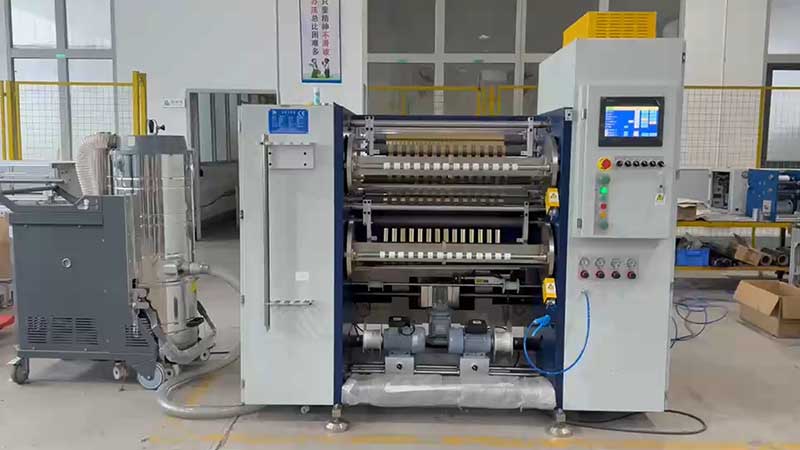
Material compatibility: There is no universal tension formula
Hot stamping gold foil is not a single material. PET substrate foil has high strength and good stability, capable of withstanding high tension; Paper-based foil is relatively soft and easily stretched and deformed, requiring low tension and maintaining stability; Transfer foil and laser foil coatings have complex structures and are extremely sensitive to tension fluctuations, requiring closed-loop systems to control fluctuations to a minimum; Metallic-textured foil coatings are thicker, and excessive tension can cause the coating to peel off. Even for the same type of PET substrate foil, the tension settings for thicknesses of 12μm and 25μm are completely different. Therefore, modern slitting machine tension control systems are commonly equipped with process formula management functions, allowing operators to preset tension parameters and taper curves for different materials, widths, and thicknesses, which can be recalled with one click during order changes to reduce human setting errors. This may seem like a convenience function, but in reality, it is an institutionalized acknowledgment of the fact that "tension control cannot exist independently of material properties."
From current regulation in magnetic particle brakes to millisecond-level torque response in servo direct drives; From a single constant tension setting to the coupling linkage of segmented taper and roller pressure—the evolution of hot stamping foil slitting machine tension control technology reflects a more fundamental question: in the processing of micron-level brittle materials, the boundary between "loose" and "tight" is extremely narrow, and the real test of technology is the ability to maintain tension stably within that narrow window during high-speed dynamic processes. As slitting speeds continue to climb to higher levels, the intervention of edge computing and AI predictive control may further reduce response time to under 10ms, but the core logic remains unchanged: the ultimate goal of tension control is to ensure that each foil layer bears just the right amount of stress during winding—neither loose nor tight—and completes the transition from wide master roll to precision narrow coil in just the right state.
 English
 Deutsch
 Français
 Español
 Português
 日本語
 русский
 한국어
 عربي
 ภาษาไทย
 Tiếng Việt
 Italiano
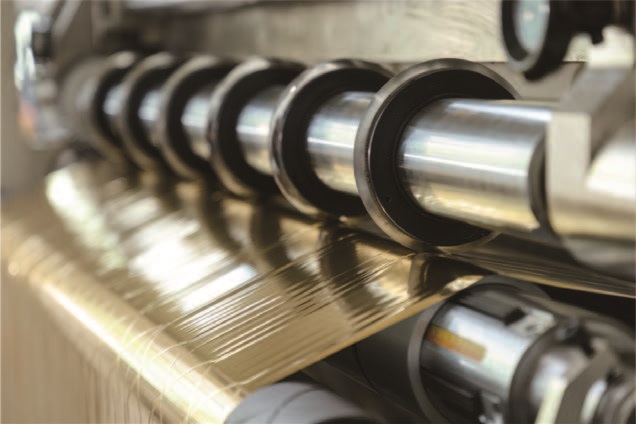
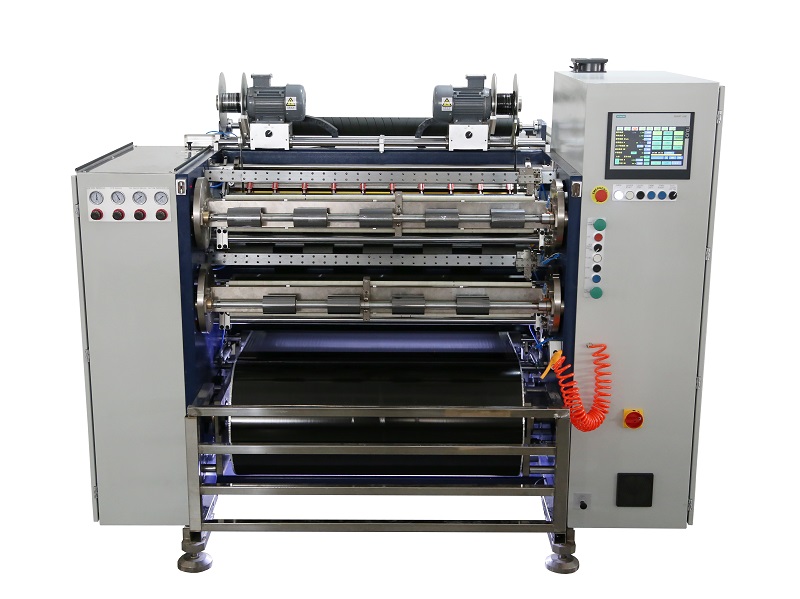 Fully Automatic TTR Slitter RSDS8 Plus
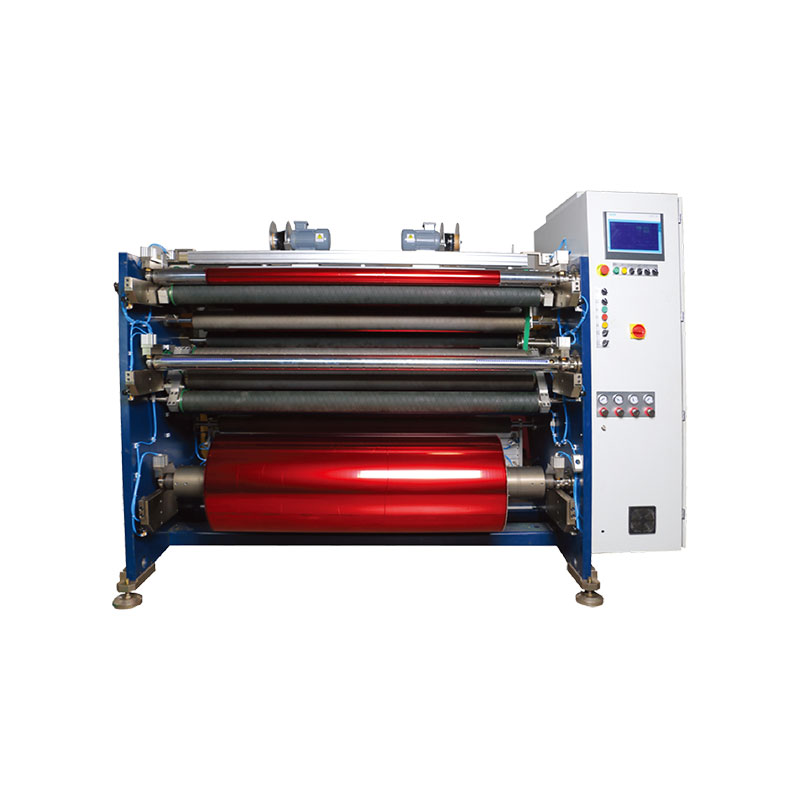 Hot Stamping Foil Slitter 1600mm
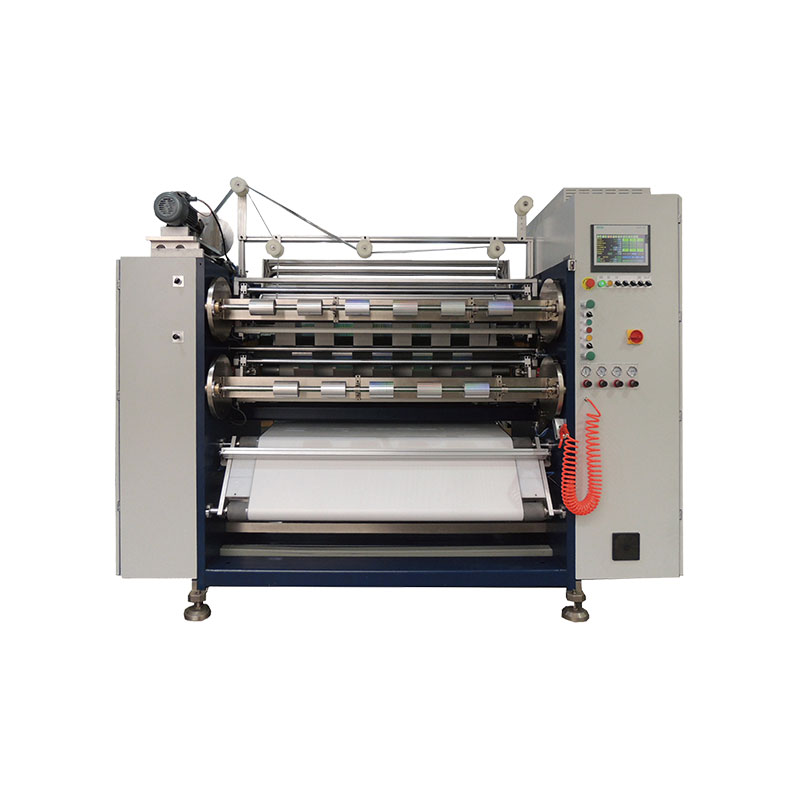 Hot Stamping Foil Slitter (4 Shafts)
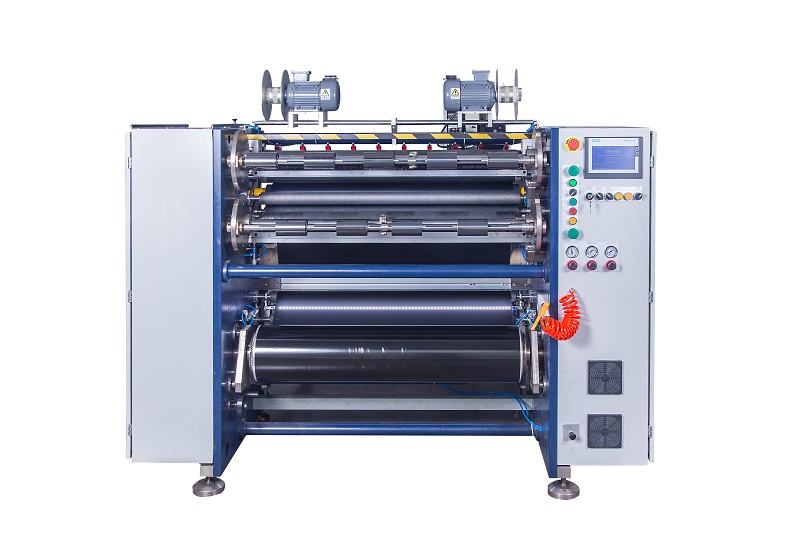 Semi-Auto TTR Slitter RSDS2 Plus
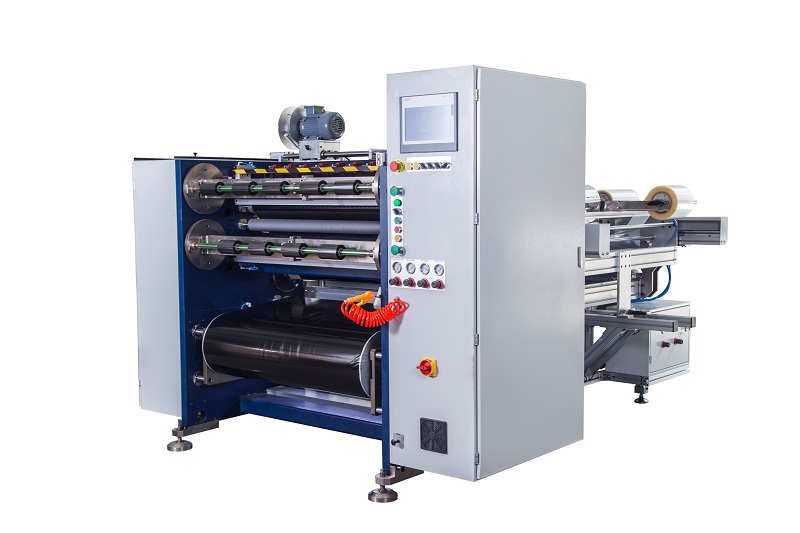 Semi Automatic TTR Slitter RSDS5 Plus
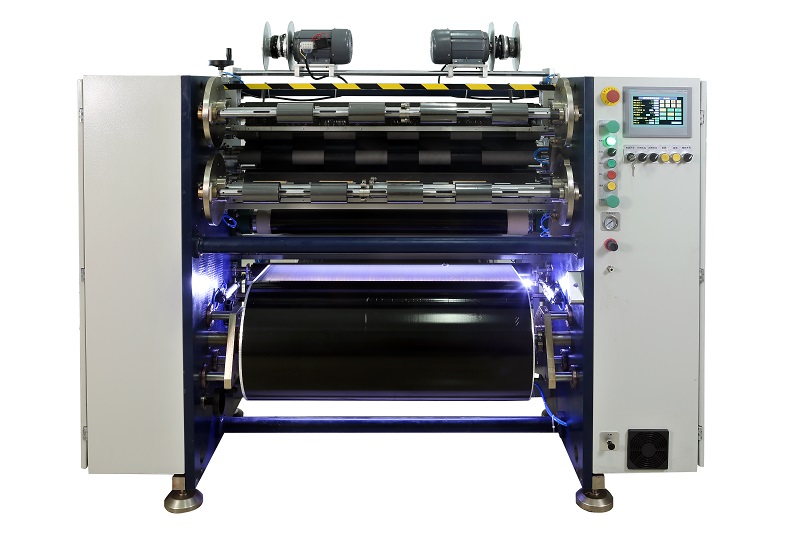 Manual TTR Slitter RSDS2
 Auto Paper Core Cutter
 Film Slitting Machine



 +86 135 9951 7291
 support@delishgroup.com
 +86 135 9951 7291
