27. March, 2026delish0
In the field of solar film production and processing, slitting accuracy directly determines product quality, material utilization and enterprise efficiency. As the market size of automotive film and architectural film continues to expand, customers have increasingly stringent requirements for the dimensional accuracy and edge flatness of solar film. This paper will systematically discuss the key technologies of precision control of solar film slitting machine from the two core dimensions of tension control and knife die optimization.
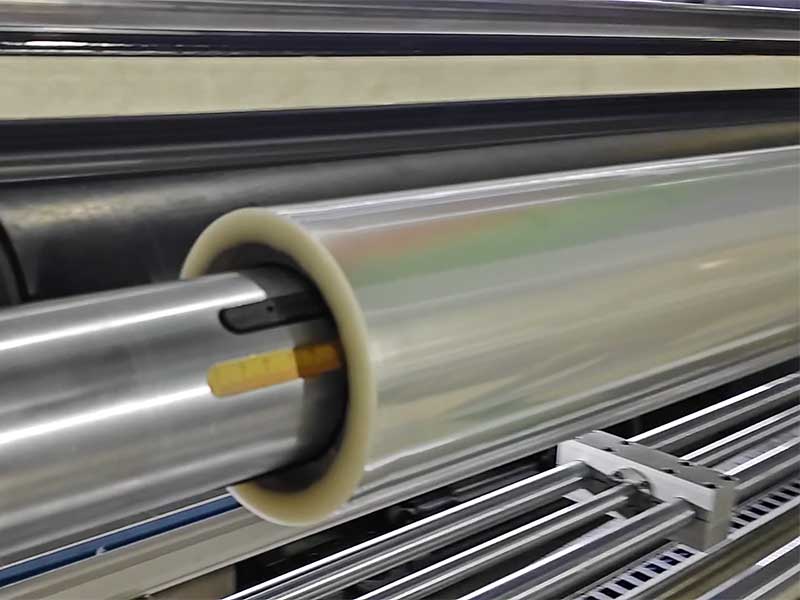
1. Tension control: the basic guarantee of slitting accuracy
Tension control is the most basic and critical influencing factor in the slitting process. As a multi-layer composite structure material (usually including release layer, mounting adhesive layer, PET base film, functional layer, and protective layer), the elastic modulus and elongation of the solar film are different between different layers, and the sensitivity to tension changes is extremely high.
1. Typical defects caused by unstable tension
• Dimensional deviation: When the tension is too large, the film coil is stretched during the slitting process, and the stress is released after winding, resulting in the actual width being less than the set value; If the tension is too small, the film surface will relax, and deviations and deviations will occur frequently
• Edge waves: Uneven tension causes ruffles or wavy edges on the membrane edges, which affects the bonding effect in the subsequent process
• Uneven end face: The fluctuation of winding tension makes the end face of the finished coil uneven, and in severe cases, the phenomenon of "telescope" occurs
• Wrinkles and scratches: Uncontrolled tension causes relative sliding between the membrane surface and the guide rollers, forming axial scratches or longitudinal folds
2. Optimization strategy for tension control
Combined application of open-loop and closed-loop control
Modern high-precision slitting machines generally adopt a closed-loop tension control system, which monitors the tension of the film surface in real time through the tension sensor, feeds back the signal to the PLC, and automatically adjusts the braking torque of the unwinding shaft and the driving torque of the rewinding shaft. For multi-layer composite films, constant tension control should be used in the winding section, and taper tension control should be used in the winding section - as the coil diameter increases, the tension should be gradually reduced to avoid compression and deformation of the inner layer.
The practice of zoning tension management
The solar film slitting process can be subdivided into three tension zones:
| area | Control target | Key parameters: |
| Rolling area | Stable unwinding to prevent slippage between layers | Brake torque and unwinding reel diameter detection |
| Traction area | Keep the film surface flat and provide a stable state for slitting | Traction roll speed ratio, floating roller position |
| Rewinding area | Ensure the quality of the roll and the end face is neat | Taper curve, pressure roller |
For solar films of different thicknesses and structures, it is necessary to establish a differentiated tension parameter library. For example, the recommended tension difference between a ceramic film with a thickness of 2 mil and a safety film with a thickness of 6 mil can be more than 40%.
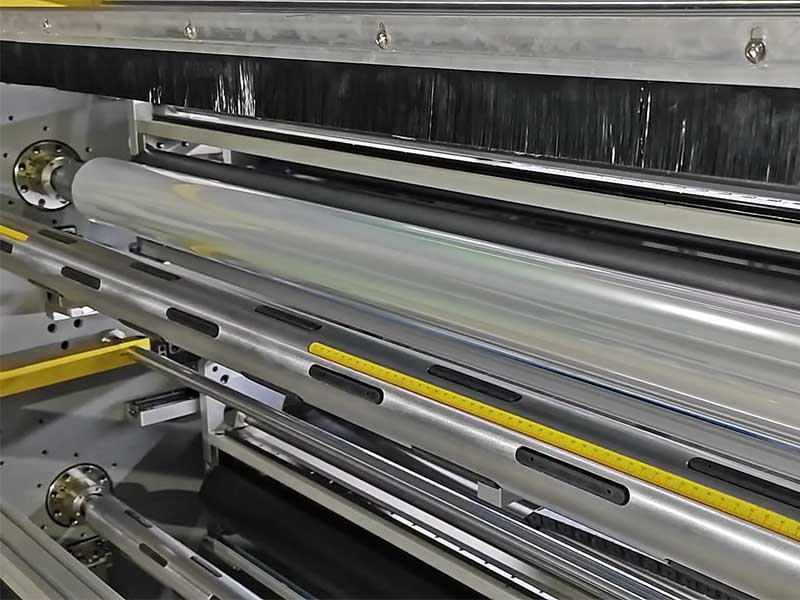
2. Knife die system: the execution unit of precision realization
The knife die system is the "last mile" after tension control. No matter how stable the tension is, if the accuracy of the knife die system is insufficient, it is still impossible to obtain qualified products.
1. Types and applicable scenarios of slitting knife dies
There are two main types of knife dies for solar film slitting:
• Circular cutter slitting: suitable for continuous, high-speed slitting. The upper and lower round knives are cut in half, with small shear force and smooth incisions, which is the mainstream choice at present. The round knife material, cutting edge angle, and tool clearance are the core control points
• Flat knife slitting: suitable for narrow strip slitting or thick film slitting. It adopts the form of upper knife and lower anvil, with a simple structure, but the blade wears out quickly after long-term operation
2. Key technologies for tool die optimization
Quantitative control of tool accuracy
In circular knife slitting, the axial offset and radial clearance of the upper and lower knives directly determine the quality of the cut. The ideal radial clearance should be 5%-10% of the film thickness. Too small a gap will produce burrs, and too large a gap will stretch the white edge or cut continuously. The high-precision slitting machine should be equipped with a digital display tool setter to control the tool setting accuracy at the level of 0.01mm.
Tool life management and replacement standards
Tool wear is a gradual process of deterioration in slitting accuracy. Practice shows that when the cumulative slitting length of the round knife reaches 30,000-50,000 meters, the microscopic notch of the cutting edge increases, and the incision has periodic burrs. Establishing a tool life ledger and formulating a mandatory replacement system based on length or time is more reliable than relying on the operator's experience judgment.
Tool holder rigidity and vibration suppression
The dynamic rigidity of tool holder systems is often overlooked. When the slitting speed reaches more than 150m/min, the resonance of the tool holder will cause a slight vibration, leaving a "vibration" on the edge of the film that is difficult to distinguish with the naked eye but visible in the later development. Optimizing the tool holder structure, increasing damping materials, and adjusting the natural frequency of the tool holder are necessary means in high-speed slitting scenarios.
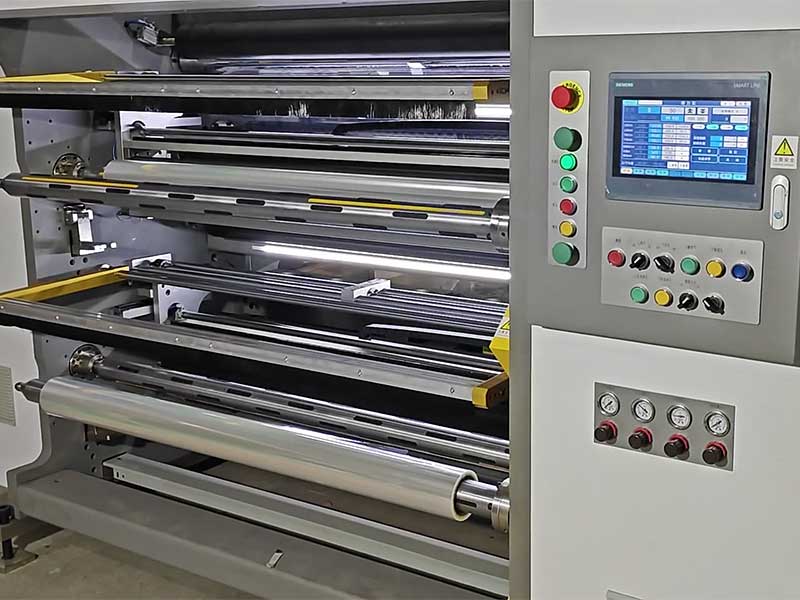
3. Collaborative optimization of tension and knife mold
Tension control and knife die system do not exist in isolation, and there is a complex coupling relationship between the two.
1. Tension-tool matching principle
• In the state of high tension, the film surface is "tightened", and the cutting resistance of the tool is small, but the incision is prone to stress and whitening
• In the low tension state, the film surface has good flexibility, but the tool is easy to "push" the film surface and deform, resulting in the cutting edge curling
The optimization method is to maintain a moderate local tension in the cut-in area, adjust the angle between the traction roller and the slitting tool holder, and increase the stabilizing roller before slitting, so that the film surface is in the ideal state of "stable but not tight" at the slitting point.
2. Closed-loop optimization based on process data
The machine vision online inspection system is introduced to monitor the state of the film edge (burr height, edge straightness, width deviation) in real time after slitting, and the detection data is correlated with the current tension set value and tool use time for analysis. When the edge quality index is detected to exceed the control limit, the system automatically prompts to adjust the tension parameters or arrange tool changes, forming a closed-loop optimization mechanism of "detection-feedback-adjustment".
4. Diagnosis and countermeasures of common problems
| Problem phenomenon | Possible causes | Solution |
| The width dimensions are out of order | Excessive tension and imbalance of traction roller speed ratio | Reduce unwinding tension and calibrate the traction roller line speed |
| Incision burrs | Tool wear and improper tool clearance | Change the tool and recalibrate the clearance |
| The membrane edges are curled | The slitting tension is too small and the tool is passive | Increase the tension in the slitting area and replace sharp tools |
| Periodic white edge | The tool holder vibrates and the guide roller is not concentric | Check the tightness of the tool holder and calibrate the dynamic balance of the guide rollers |
| The end of the winding is uneven | The winding tension taper is unreasonable and the pressure of the roller is uneven | Optimize the taper curve and adjust the roller balance |
5. Conclusion
Solar film slitting accuracy control is a systematic project, tension adjustment provides basic guarantee for accuracy, and tool die optimization provides execution ability for precision realization. In actual production, enterprises should establish a three-in-one precision control system of "equipment-process-testing": with high-rigidity, high-response slitting equipment as the hardware basis, scientific tension partition management and tool life management as the core process means, and online testing and data analysis as the basis for continuous improvement.
With the development of solar film in the direction of functionalization, thinness and multi-layering, the slitting accuracy requirements will be further improved. In the future, technologies such as adaptive tension control based on machine learning and intelligent tool condition monitoring are expected to be applied in high-end slitting equipment, promoting the slitting accuracy of solar film from the "micron level" to a higher level.
 English
 Deutsch
 Français
 Español
 Português
 日本語
日本語 русский
 한국어
한국어 عربي
عربي ภาษาไทย
 Tiếng Việt
 Italiano
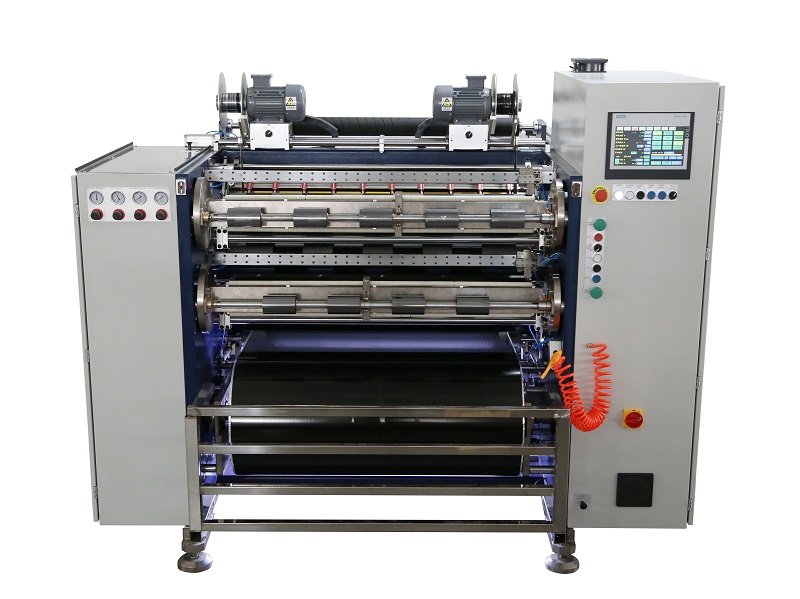 Fully Automatic TTR Slitter RSDS8 Plus
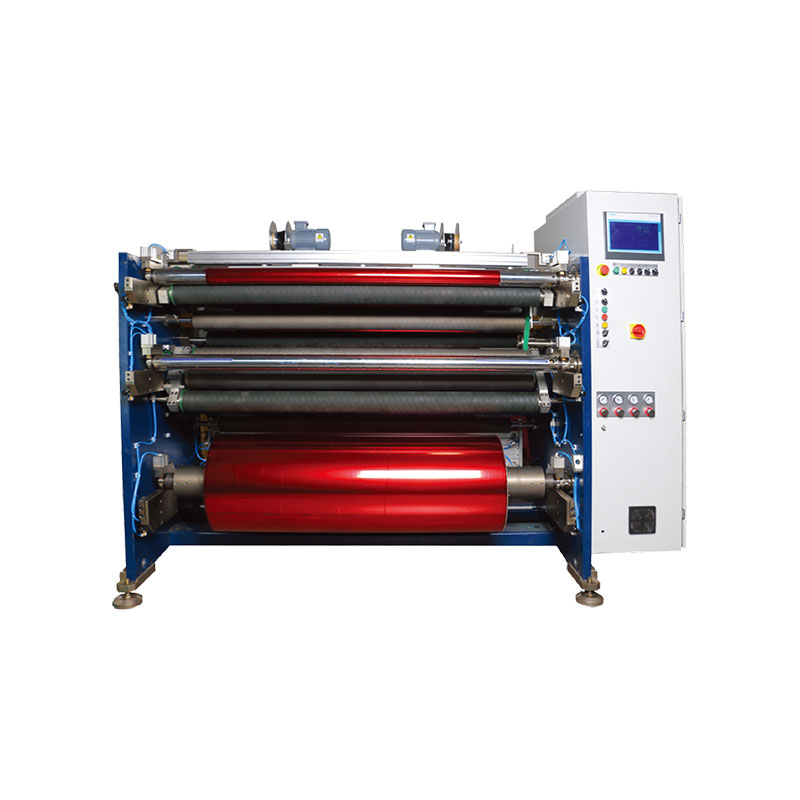 Hot Stamping Foil Slitter 1600mm
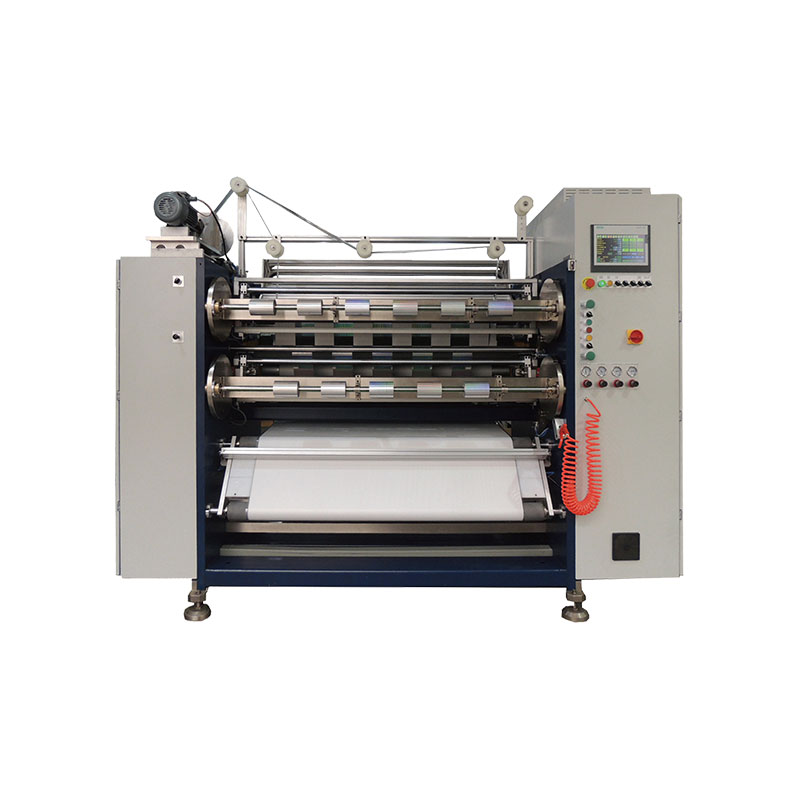 Hot Stamping Foil Slitter (4 Shafts)
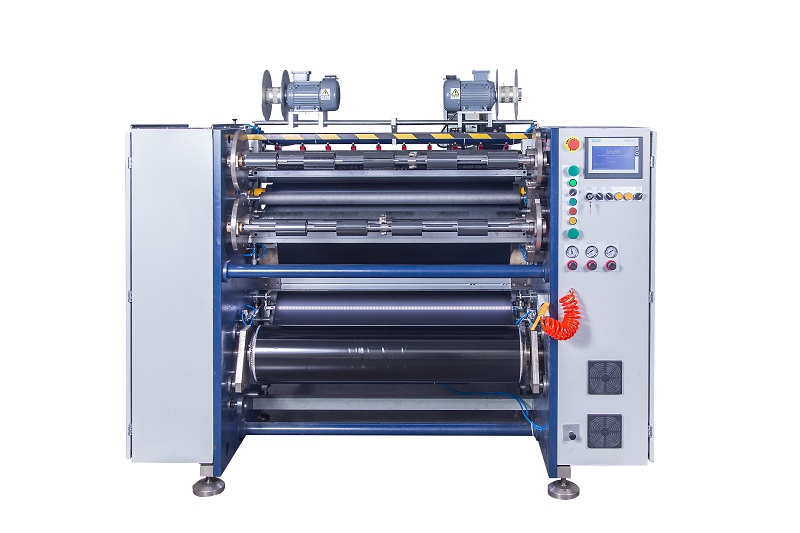 Semi-Auto TTR Slitter RSDS2 Plus
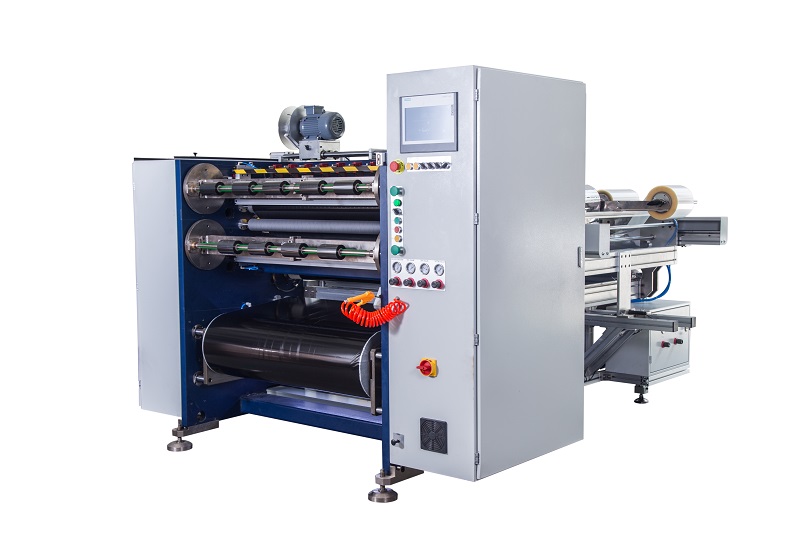 Semi Automatic TTR Slitter RSDS5 Plus
 Manual TTR Slitter RSDS2
 Auto Paper Core Cutter
 Film Slitting Machine



 +86 135 9951 7291
 support@delishgroup.com
 +86 135 9951 7291